



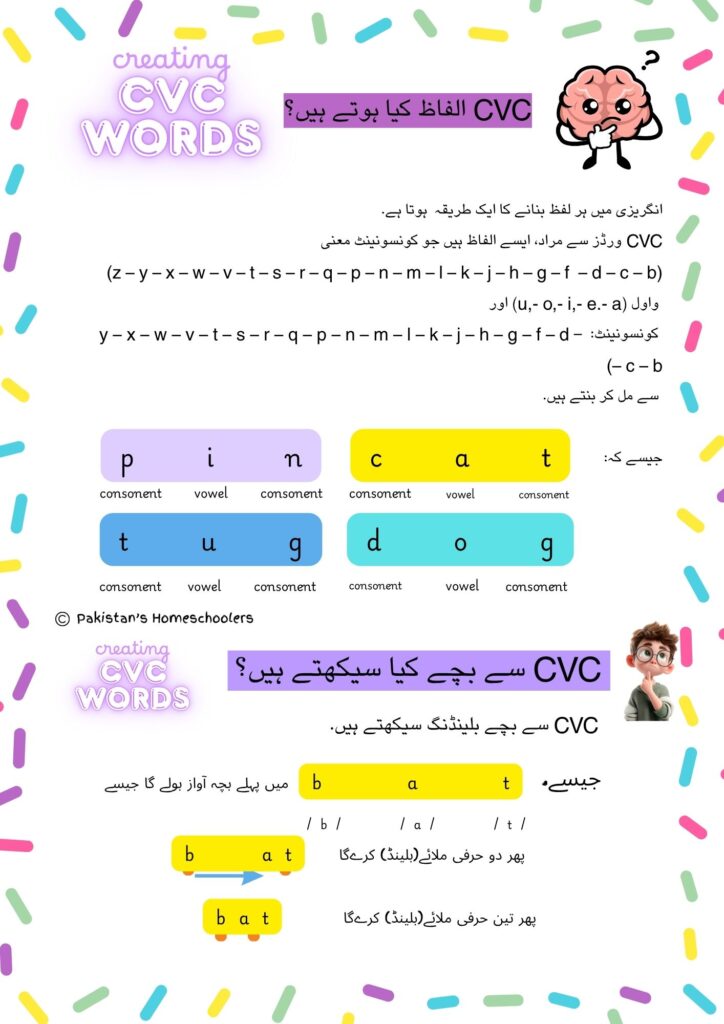
What is a CVC Word?
A CVC word stands for Consonant – Vowel – Consonant.
It is a simple, three-letter word where a short vowel sound is sandwiched between two consonant sounds. Because these words are pronounced exactly as they are spelled, they are the first real words children learn to read once they know their letter sounds!
- Examples:
-
c–a–t(cat), -
d–o–g(dog), -
s–u–n(sun), p–e–n(pen),m–a–p(map).
-
🚀 Unlocking Early Reading: The Magic of CVC Words
Hey homeschooling parents! 👋
If your little one has mastered their basic alphabet sounds and you’re wondering, “What comes next?”—welcome to the wonderful world of CVC words!
Moving from individual letter sounds like “a, b, c” to actually reading full words is one of the most exciting milestones in early home education. But how do we cross that bridge without tears or frustration?
Let’s break down what CVC words are, why they are absolute gold for beginner readers, and how you can teach them through fun, hands-on play at home!
🔍 Why Are CVC Words So Important?
Think of CVC words as the building blocks of reading. When children learn CVC words, they practice a crucial skill called blending—taking individual phonics sounds and sliding them together to form a recognizable word.
Here is why they work like magic:
- Predictable Rules: Short vowels in CVC words almost always make their standard short sounds (like the a in apple or u in up).
- Instant Confidence Boost: Because these words are short, young kids can read a whole “word” in seconds. That instant success builds huge reading confidence!
- Foundation for Fluency: Once a child masters CVC blending, they can easily move on to longer words, simple storybooks, and early sight words.
🎲 3 Fun & Interactive Ways to Teach CVC Words at Home
Forget dry worksheets! Children at the Montessori and early primary stage (ages 3 to 6) learn best through sensory, hands-on exploration. Here are three simple, interactive games you can play using simple everyday household items:
1. 🚗 The “Drive & Blend” Track
Draw a straight line across a piece of paper and write a CVC word spaced out (e.g., c … a … t). Give your child a small toy car.
- As they drive the car slowly past each letter, have them say the individual sound: “c… a… t…”
- Next, ask them to drive the car fast across the line and smooth the sounds together: “cat!”
2. 🔤 Missing Vowel Scavenger Hunt
Write down several consonant pairs on index cards (e.g., b __ g, s __ n, p __ n). Hide small cards with the vowels (a, e, i, o, u) around the room.
- Challenge your child to find a vowel and place it in the middle slot to see if they can make a real word!
- Ask them: “If we put ‘u’ in the middle of ‘b’ and ‘g’, what word do we make?” (bug!)
3. 🎨 Playdough Sound Stamps
If you have letter stamps or magnetic letters, roll out three flat pancakes of playdough side-by-side.
- Have your child press each letter into a dough pancake while sounding it out.
- Once all three sounds are pressed, let them squish the three pancakes together to “blend” the word!
💡 Quick Tips for Teaching Success
Keep Lessons Short: 5 to 10 minutes of fun daily blending practice is far more effective than an hour-long study session. End the lesson while your child is still having fun!
- Focus on Sounds, Not Letter Names: Use phonics sounds (/c/ /a/ /t/) instead of alphabet names (C – A – T).
- Don’t Rush: If your child gets stuck, take a step back and use physical objects (like counters or blocks) to represent each sound visually.
- Normalize Mistakes: If they read “cat” as “cot”, simply ask: “What sound does ‘a’ make in the middle?” Let them self-correct!
Mastering CVC words is an amazing journey that opens the door to reading independence. Try one of these simple games today and watch your young reader beam with pride!
Comments are closed