

“Mom, why do I have to learn this?”
A mother pauses while helping her child with a worksheet at the dining table. The child points towards a book about space sitting nearby.
“I want to learn about planets. Can I?”
The mother smiles. “Of course. But let’s finish this lesson first, and then we can explore the topic together.”
It is a simple conversation, but it raises an important question:
How much structure does a child need to learn effectively—and how much freedom should a child have to follow their own interests?
For many Pakistani parents, education traditionally means one thing: sending children to a good school, following the prescribed curriculum, preparing for examinations, and making sure they move successfully from one grade to the next.
But education is changing.
Around the world, families are exploring alternatives such as homeschooling, unschooling, Montessori education, online learning, and other child-centred approaches.
Among these, homeschooling and unschooling are often confused with one another. While both can take place outside a traditional school, they are based on quite different approaches to learning.
So, what exactly is the difference?
And more importantly, which approach can work for a child and family in Pakistan?
Let’s take a closer look.
Traditional Schooling: The System Most of Us Know
Traditional schooling is the model most Pakistani families are familiar with.
A child attends a school according to a fixed timetable, studies a prescribed curriculum, learns different subjects according to grade level, completes assignments, takes assessments, and progresses through the education system.
Schools usually have clearly defined roles for students, teachers, parents, and administrators. In many school systems, particularly at the secondary level, curriculum requirements and examinations are standardised.
What are the strengths of traditional schooling?
Traditional schooling can offer several important advantages:
1. Structure and routine
Children know when their school day begins, what subjects they will study, and what is expected from them.
2. Clear academic expectations
A defined curriculum gives parents and teachers a framework for tracking academic progress.
3. Social interaction
School gives children regular opportunities to interact with peers, participate in group activities, develop friendships, and learn teamwork.
4. Access to teachers and resources
Children can learn from teachers who specialise in particular subjects and can benefit from laboratories, libraries, sports facilities, activities, and other school resources.
For many families, these advantages make traditional schooling a practical and familiar choice.
However, traditional schooling is not automatically the perfect fit for every child.
When the System Becomes the Problem
One of the challenges of a highly structured education system is that children do not always develop at exactly the same pace.
Consider the example of Aaliyaan and Zoya.
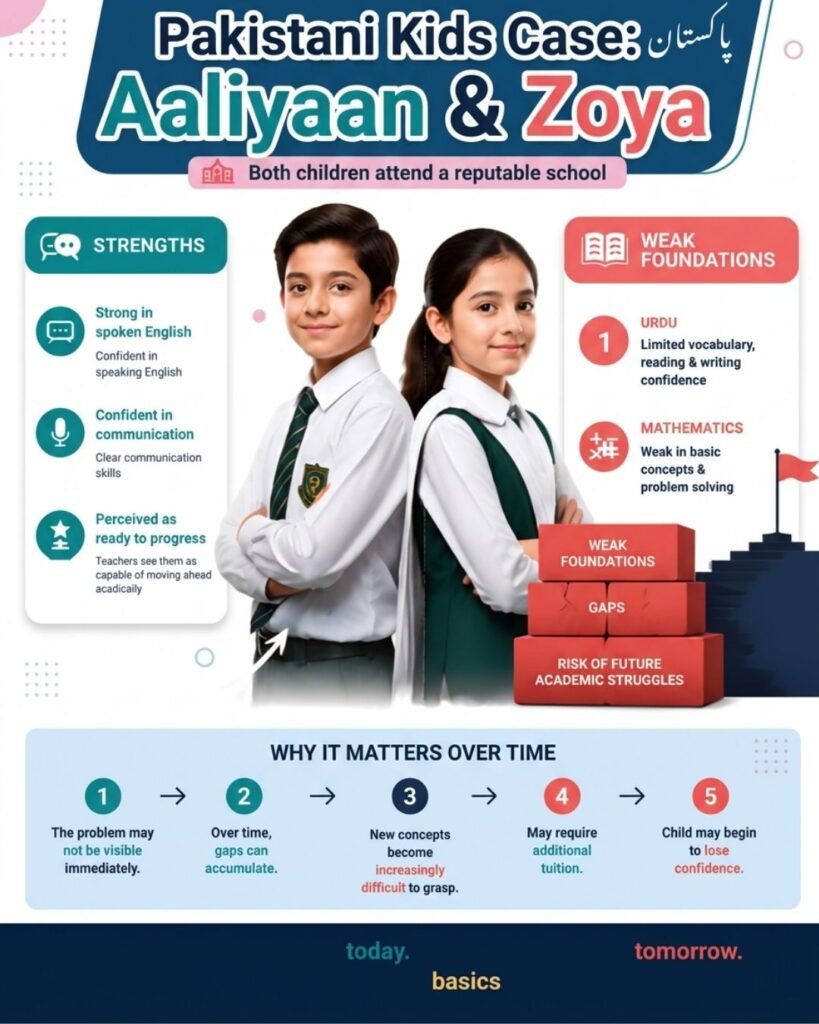
Was promoting them necessarily wrong?
Not necessarily.
The issue is how readiness is assessed.
Academic readiness should ideally consider more than one visible skill. A child may speak excellent English but still need additional support in Mathematics, reading comprehension, writing, or other foundational areas.
A stronger approach would be to identify learning gaps early and provide:
- Remedial support
- Additional practice
- Individual attention
- Differentiated instruction
- Regular assessment of foundational skills
The goal should not simply be to move a child to the next grade.
The goal should be meaningful learning.
Homeschooling: Bringing Education Home
This brings us to homeschooling.
Homeschooling does not simply mean “studying at home.”
At its core, homeschooling means that parents take primary responsibility for their child’s education outside the conventional school environment.
That education may involve:
- A formal curriculum
- Textbooks and workbooks
- Online classes
- Tutors
- Montessori materials
- Educational activities
- Projects and experiments
- Field trips
- Religious and moral education
- A combination of several approaches
This flexibility is one of homeschooling’s greatest strengths.
But flexibility should not be confused with the absence of structure.
What Does Successful Homeschooling Require?
1. Parents Need a Shared Vision
Homeschooling is a significant family commitment.
Ideally, both parents should understand why they are choosing homeschooling and what they hope to achieve.
It becomes difficult when one parent expects a structured academic programme while the other expects completely flexible, child-led learning.
A shared understanding makes the journey much easier.
2. Someone Needs to Facilitate Learning
A homeschooling parent does not necessarily have to become a professional teacher.
Instead, the parent often becomes a facilitator.
This means understanding the child’s needs, selecting appropriate resources, creating learning opportunities, observing progress, and seeking outside help when necessary.
The parent’s role is not to know everything.
It is to make sure the child has opportunities to learn.
3. A Routine Still Matters
One of the biggest misconceptions about homeschooling is that children simply wake up whenever they want and study whenever they feel like it.
That may be the approach of some families, but it is not what homeschooling necessarily means.
A child benefits from knowing that different parts of the day have different purposes.
For example:
2:00–4:00 PM: Academic learning and focused study
5:00–7:00 PM: Outdoor play, physical activity and social time
Other parts of the day: Meals, rest, family time, reading and character development
The exact timings will vary from family to family.
The important point is not the clock.
It is consistency.
Children need both freedom and boundaries.
Do Parents Have to Teach Everything Themselves?
Absolutely not.
This is another common misconception.
A parent may be comfortable teaching English but struggle with advanced Mathematics. Another parent may be excellent at Science but need help with a particular language.
Homeschooling allows families to seek outside support.
This can include:
- Online teachers
- Subject-specific tutors
- Learning centres
- Educational workshops
- Science and practical activities
- Sports coaches
- Art and music instructors
- Educational communities
There is no rule saying that a homeschooling parent must personally teach every subject.
In fact, knowing when to ask for help is an important part of successful homeschooling.
Benefits of Homeschooling
When thoughtfully planned, homeschooling can offer several advantages.
Individualized Learning
Children can spend more time on areas they find difficult and move faster through areas they understand well.
Greater Parental Involvement
Parents have a closer understanding of their child’s academic development, interests, strengths and challenges.
Flexibility
Families can adjust schedules according to their circumstances instead of following a fixed school timetable.
Values and Character Development
Parents can consciously incorporate moral, cultural, religious and family values into the child’s education.
Potential Cost Savings
Depending on the resources and services a family chooses, homeschooling may reduce some expenses associated with school fees, transport, uniforms and other school-related costs.
However, homeschooling is not automatically inexpensive. Curriculum materials, tutors, technology, activities and educational resources can also require significant investment.
Homeschooling Has Challenges Too
Homeschooling should not be presented as an effortless alternative to school.
It requires time, patience, planning and consistency.
Parents may struggle with:
- Maintaining a routine
- Finding appropriate curriculum resources
- Balancing household responsibilities
- Teaching multiple children at different levels
- Providing sufficient social opportunities
- Measuring academic progress
- Preparing children for future examinations or formal qualifications
For Pakistani families, there may also be practical questions around board examinations, university admissions, documentation and future academic pathways.
These are issues parents should think about before choosing a homeschooling model.
So, What Is Unschooling?
This is where the distinction becomes important.
Homeschooling and unschooling are not the same thing.
Homeschooling can be structured around a curriculum.
Unschooling is generally much more child-led.
Instead of beginning with the question:
“What does the curriculum say the child should learn today?”
an unschooling family may begin with:
“What is the child curious about?”
A child interested in animals might spend days reading about wildlife, watching educational material, drawing animals, visiting a zoo, learning statistics about endangered species, and writing a project about conservation.
Mathematics, reading, writing, science and other skills may become part of that exploration.
The emphasis is on learning through curiosity, experience and real-life interests rather than following a fixed sequence of lessons.
Homeschooling vs. Unschooling
The simplest way to understand the difference is this:
| Homeschooling | Unschooling |
|---|---|
| Can follow a curriculum | Usually does not follow a fixed curriculum |
| Parents generally plan learning | Child’s interests strongly influence learning |
| Often includes structured lessons | Learning may emerge naturally from everyday life |
| Academic goals are usually planned | Goals can develop through the child’s interests |
| Routine is often clearly defined | Routine can be much more flexible |
| Parent acts as teacher/facilitator | Parent primarily acts as facilitator and learning partner |
There can, of course, be a lot of variation between families.
Not every homeschool looks the same, and not every unschooling family follows exactly the same philosophy.
Is Unschooling the Same as Letting Children Do Whatever They Want?
Not necessarily.
This is an important distinction.
Unschooling does not have to mean unparenting.
A child-led approach can still involve parents who provide books, resources, experiences, conversations, guidance and boundaries.
The parent remains responsible for creating a safe and stimulating environment.
The question is how much direction the parent provides.
A structured homeschool may say:
“Today we are studying fractions.”
An unschooling approach might begin with:
“You want to bake a cake? Great. How much flour do we need? What happens if we double the recipe?”
Both approaches can involve learning.
The difference lies largely in where the learning begins and who determines its direction.
What About the Concerns Around Unschooling?
Unschooling has attracted both supporters and critics.
Supporters argue that children are naturally curious and that learning can happen through everyday experiences rather than being confined to textbooks and classrooms.
Critics, however, raise an important concern:
What happens if a child never develops essential skills such as literacy, numeracy or scientific understanding?
This is not a question parents should ignore.
A child may be deeply interested in art, technology, animals or gaming, but education also requires exposure to areas that may not immediately interest them.
This is one reason parents considering an unschooling approach need to remain observant and actively involved.
The debate is not simply about freedom versus rules.
It is about finding the right balance between:
Curiosity + Guidance + Foundational Skills + Independence
What Can Pakistani Parents Learn From This Debate?
This discussion is particularly relevant in Pakistan.
Our education system places significant emphasis on examinations, grades, board results and academic progression.
For many parents, the natural response to academic pressure is additional tuition.
A child goes to school in the morning, attends tuition in the afternoon, completes homework in the evening, and then prepares for tests.
But perhaps the bigger question is:
Is the child actually learning—or simply completing the next task?
Homeschooling can provide an opportunity to slow down and identify how a child learns best.
Montessori-inspired education can encourage independence and hands-on learning.
Unschooling can encourage curiosity and child-led exploration.
Traditional schooling can provide structure, peer interaction and access to trained teachers.
None of these approaches is automatically perfect.
The right choice depends on the child, the family, available resources and long-term educational goals.
There Is No One-Size-Fits-All Education
A child who thrives in a structured classroom may not need homeschooling.
Another child may flourish with individualised learning at home.
Some families may prefer a structured homeschool.
Others may incorporate elements of child-led learning.
And some may choose a hybrid approach that combines home education, tutors, online classes and community activities.
The important thing is not to choose an educational label simply because it is trending.
Instead, ask:
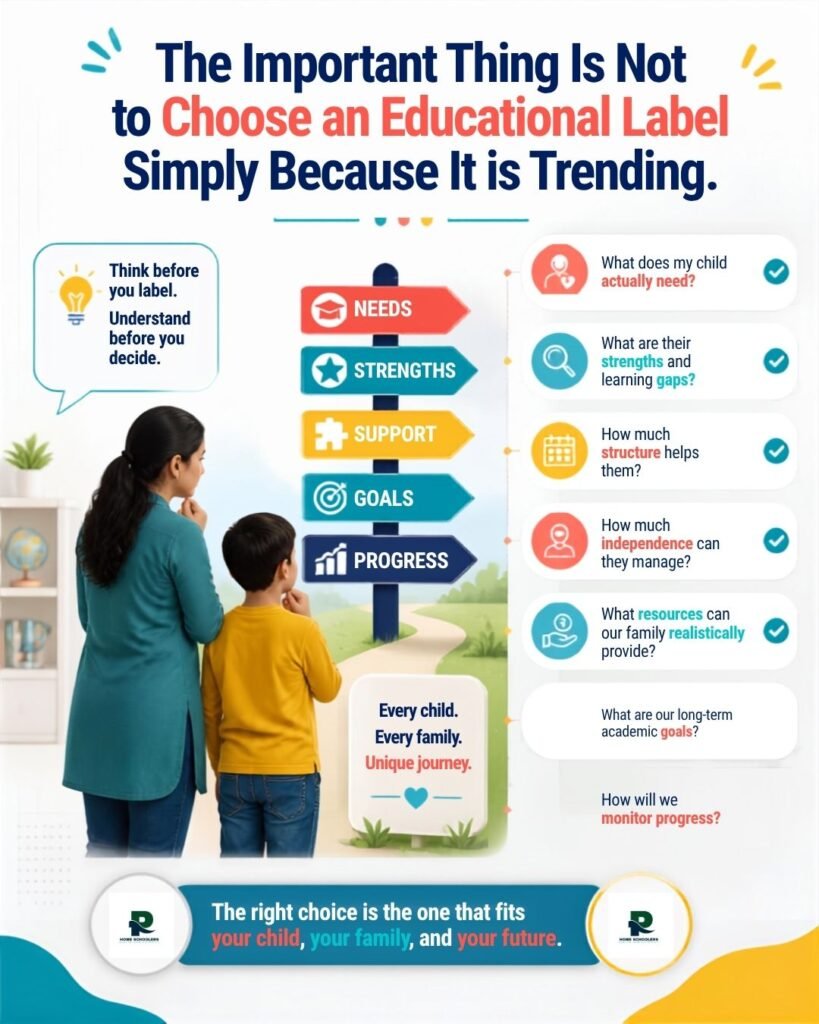
These questions are far more useful than simply asking whether homeschooling or unschooling is “better.”
The Most Important Factor: Consistency
Whatever educational path a family chooses, consistency matters.
Changing approaches every few weeks can create confusion for both parents and children.
If you choose traditional schooling, remain involved in your child’s education.
If you choose homeschooling, create a realistic routine and monitor progress.
If you choose a child-led approach, remain an active facilitator rather than simply stepping away from the learning process.
Education requires patience.
Children develop at different rates. Some concepts take time. Some days go beautifully; others do not.
That is normal.
The goal is not to create a perfect educational journey.
The goal is to raise a child who knows how to learn, think, communicate, solve problems and continue learning throughout life.
The Final Decision Is Yours
Traditional schooling, homeschooling and unschooling each offer different possibilities.
Traditional schooling provides structure and a social learning environment.
Homeschooling gives families greater control and flexibility over education.
Unschooling places greater emphasis on curiosity, independence and child-led learning.
The real question is not:
“Which system is the best?”
It is:
“Which environment will help my child learn, grow and become an independent, responsible and confident person?”
For Pakistani parents, this decision deserves careful thought. Our children will eventually have to navigate a world that values not only academic qualifications, but also communication, creativity, problem-solving, adaptability and lifelong learning.
Whatever path you choose, remember one thing:
Education does not end when the school day ends.
A child’s greatest classroom is the world around them—and parents have an important role in helping them learn how to navigate it.
Your time, attention, patience and consistency can make a far greater difference than the name of the educational system you choose.
Choose thoughtfully. Observe your child. Adapt when necessary. And above all, keep learning together.
No responses yet